
Sudoku rules cheat sheet
Fill every empty cell with a digit from 1 to 9. Keep the starting digits unchanged, and make every row, column and 3 by 3 box contain each digit exactly once.
Download US Letter PDF Download A4 PDF
Each English PDF is one page, with labeled grid diagrams, key terms and a first-move example. Download directly without an email address or account. Print at actual size on the matching paper size.
For a quick web explanation, read Sudoku rules. For help during a solve, browse practical Sudoku tips.
The three rules of Sudoku
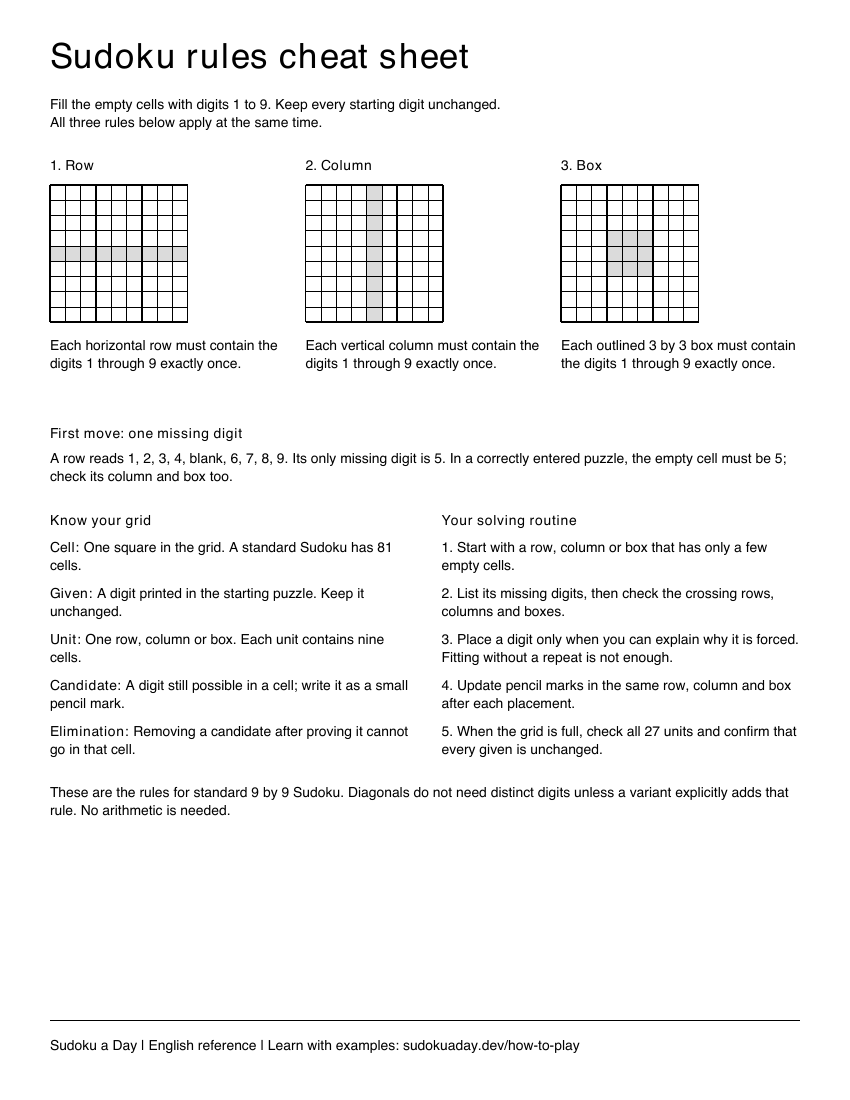
- Row: Each horizontal row must contain the digits 1 through 9 exactly once.
- Column: Each vertical column must contain the digits 1 through 9 exactly once.
- Box: Each outlined 3 by 3 box must contain the digits 1 through 9 exactly once.
A first-move example
A row reads 1, 2, 3, 4, blank, 6, 7, 8, 9. Its only missing digit is 5. In a correctly entered puzzle, the empty cell must be 5; check its column and box too.
If the column or box already contains a 5, pause and check for an earlier mistake or a copied digit. Do not change a given to make a move fit.
Know your grid
- Cell: One square in the grid. A standard Sudoku has 81 cells.
- Given: A digit printed in the starting puzzle. Keep it unchanged.
- Unit: One row, column or box. Each unit contains nine cells.
- Candidate: A digit still possible in a cell; write it as a small pencil mark.
- Elimination: Removing a candidate after proving it cannot go in that cell.
A simple routine for your first puzzle
- Start with a row, column or box that has only a few empty cells.
- List its missing digits, then check the crossing rows, columns and boxes.
- Place a digit only when you can explain why it is forced. Fitting without a repeat is not enough.
- Update pencil marks in the same row, column and box after each placement.
- When the grid is full, check all 27 units and confirm that every given is unchanged.
A naked single is a cell with one remaining candidate. A hidden single is a digit with only one possible cell in a unit. Our beginner course shows how to recognize both on a grid.
Preview the printable rules sheet
Frequently asked questions
Can a number repeat anywhere in the grid?
Yes. A completed grid contains each digit nine times overall. The restriction is that no digit repeats within any one row, column or box.
Do the diagonals count?
Not in standard Sudoku. Some variants add diagonal constraints; follow those extra rules only when the puzzle specifies them.
Is a digit correct if it does not repeat?
Not necessarily. Several digits can be locally possible in an empty cell. Use the rest of the puzzle to prove which one belongs there before making a permanent entry.
How is this different from the strategy cheat sheet?
This sheet explains the constraints every solution must satisfy. The strategy cheat sheet summarizes techniques for finding placements and eliminating candidates once you know those rules.
Ready to practice? Play today's puzzle, choose printable puzzles with answers, or use a blank grid for your notes.