
Sudoku strategy cheat sheet
Keep 11 useful techniques beside your puzzle, from singles to fish and wings. Download a one-page English reference, or use the reminders below to jump to a worked example.
Download US Letter PDF Download A4 PDF
Free downloads, no email or account required. Each file is one page. Print at actual size using the matching paper size.
Before you use the sheet
New to Sudoku? Start with the rules cheat sheet for the three constraints and a printable grid reference.
A candidate is a digit still possible in a cell. A unit is a row, column or 3 by 3 box. Two cells see each other when they share a unit. Keep your pencil marks complete and up to date: a missing note can make a pattern look valid when it is not.
11 techniques at a glance
Start here
- Cross-hatching: Choose a digit and a box. Use its placements in intersecting rows and columns to rule out cells. If only one position remains in the box, place it.
- Naked single: A cell has just one remaining candidate after checking its row, column and box. Place that digit.
- Hidden single: A missing digit has only one possible cell in a row, column or box. Place it, even if the cell has other candidates.
Reduce candidates
- Naked pair: Two cells in one unit each contain exactly the same two candidates. Remove those digits from every other cell in that unit.
- Naked triple: Three unsolved cells in one unit have a combined set of exactly three candidates. Remove those digits from other cells in the unit. Each cell need not contain all three.
- Hidden pair: Two digits can appear only in the same two cells of one unit. Keep those two digits in those cells and remove their other candidates.
- Pointing pair or triple: Within a box, all candidates for a digit lie in one row or column. Remove that digit from the rest of that line outside the box.
Look further
- X-Wing: A digit has exactly two candidate positions in each of two rows, in the same two columns. Remove it from other cells in those columns. Rows and columns can be swapped.
- Swordfish: In three rows, a digit has two or three positions per row, all confined to the same three columns. Remove it from those columns outside the three rows. The pattern also works with columns as the base.
- XY-Wing: A cell with exactly XY sees cells with exactly XZ and YZ, where X, Y and Z are distinct digits. Remove Z from other cells that see both wings. Seeing just the pivot is not enough.
- Simple coloring: color trap: For one digit, alternate two colors along one connected network of strong links: units with exactly two positions for that digit. Remove an uncolored candidate that sees both colors.
Preview the printable sheet
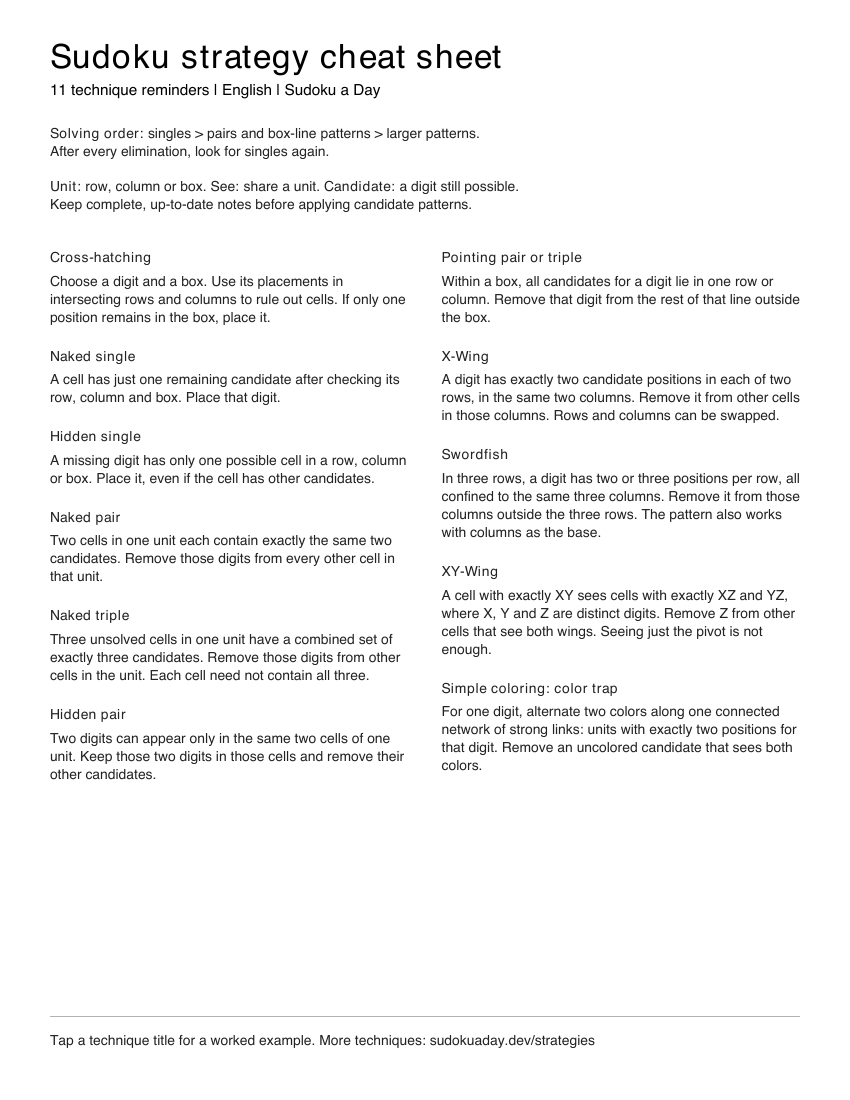
Use the reminder, then practice the pattern
Start with a technique you can explain. Follow its link above to see the candidate grid and each step. On your own puzzle, confirm the complete pattern before placing a number or removing a candidate. An elimination narrows the possibilities; it does not always reveal a placement immediately.
These groups suggest a learning order. Difficulty labels vary between puzzle collections, and this sheet is a selection of useful techniques, not every possible method. Explore the full strategy library for more patterns.
Frequently asked questions
Which techniques should I learn first?
Begin with cross-hatching, naked singles and hidden singles. Once those feel familiar, practice pairs and pointing patterns before moving to fish or wings.
Does this include worked examples?
The PDF is a compact reminder sheet. The linked technique guides include the worked grid examples, so you can learn a pattern before using the short reference.
What if none of these techniques helps?
Check your notes and earlier moves, then revisit singles. Our guide to getting unstuck offers a more detailed routine.
Choose practice puzzles with answers, or download a blank grid to work through a pattern on paper.